PUT ON A PUNK SHOW

Find a Room. Find Some Bands. Make Something Happen.
So, you went to a punk rock show, or hardcore, if you like, at a nightclub. They had a wall of sound, lights, a sound guy, a pretty professional setup. They also charged you more than 25 bucks to get in. Drinks were seven or ten bucks. There was a big merch table, maybe even club merch. They had a budget, a bank account, and a team of people whose job it was to bring in bands, sell tickets, and make money. That's cool. That's their job. Clubs are there to bring in entertainment for us to enjoy. But that's not the kind of show I'm talking about. I'm talking about putting on your own show.
HOW WE DID IT
Back in the early 1980s, if you wanted to see a punk band play live, you usually had to go to a club in the city. Shows might run from 9 PM until 2 AM. The cover was usually pretty cheap, but there were a few problems. First, a lot of us were teenagers. We didn't have cars, and public transportation sucked. Where I lived, the state buses stopped running around midnight. You could get to the show, but getting home was another matter.
Then there were state laws and club rules. A lot of shows were 21-plus. That meant many of us couldn't get into the clubs to see bands. It also meant teenage punk bands had very few places where they could actually play. So, what was a punk supposed to do? We found somewhere else.
BASEMENTS, GARAGES AND BACKYARDS
We saw bands, and played in bands, in people's basements, garages and backyards. We, the kids in the scene, put on the shows. We knew the local bands, so we got them to play. We knew people who wanted to see them, so we told everybody where to go. If somebody had a house available, that was the easy version. Sometimes their parents were cool with it. Other times their parents were conveniently out of town. A house show didn't require much promotion. Get some bands. Tell people. Word traveled. Then everybody showed up. Sometimes far more people than whoever owned the house expected.
FIND A ROOM
If you wanted something bigger, you needed a room. That's where social clubs came in. VFW halls. American Legions. Polish clubs. French clubs. Italian clubs. Church basements. Community halls. Whatever we could find. You'd walk in and try to convince whoever was in charge to let a bunch of kids use their hall for a show. Here's the funny part. Back then, we usually didn't lead with the words PUNK ROCK SHOW. That could end the conversation pretty quickly. We were "some kids with rock bands looking for a place to play." Sometimes it worked. We could occasionally get a hall for free or almost nothing on a Sunday afternoon. And that room became our venue. There wasn't a professional PA waiting for us. Maybe the hall had a microphone and a couple of speaker-amps. That was about it.
The bands brought what they had. We shared amps. We shared microphones. Sometimes everybody used the same drum kit. There was no sound guy. There was no light show. Most of the time the room was fully illuminated by some of the most unforgiving fluorescent lights ever manufactured. It wasn't glamorous. But it was ours, and we made it happen.
FIVE-CENT FLYERS AND STOLEN PHOTOCOPIES
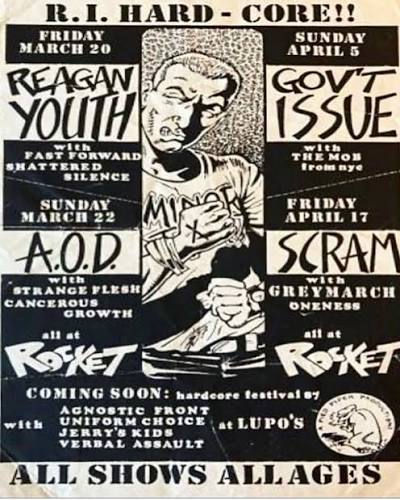
For a social club show, we actually had to advertise. There was no Facebook event. No Instagram. No online ticketing. We made flyers with pens, markers, scissors, whatever artwork we could find, and our questionable artistic abilities. Band names. Band logos. Date. Time. Location. Price. Then we needed copies. The library charged something like five cents a copy. Of course, five cents was five cents. So, sometimes we found other solutions. At school, that might mean sneaking into the teachers' lounge and using the photocopier for free. Then we'd take those flyers everywhere. Telephone poles. Bulletin boards. Record stores. Other shows. Anywhere we thought somebody might see one. We'd go around town, into other towns, and into the city. That was how you promoted a show.
Then, when the day came, we worked the show. We worked the door. We sold whatever merch there was. We helped with gear. We tried to keep things under control. We cleaned up. We did all of it. We made the scene. It was ours.
SOMETIMES IT WENT TO SHIT
I don't want to make this sound more romantic than it was. Sometimes these shows went great. Other times they went drastically wrong. There were shows where only a handful of kids showed up. Other times we packed the place. Gear broke. The sound could be awful. Bands didn't always show up. There were fights. There were even a few times when things got completely out of control. Sometimes every band played a full set. Other times the venue shut us down before the first band finished. Sometimes we were invited back. A lot of the time it was a one-shot deal. You never really knew.
I remember one show where we had a packed house and the venue shut us down. The kids were pissed. People started yelling "fascists" at the VFW guys. Then came the pushing. Then the fists. Then the cops. At that point, most of us were either getting tossed out or already running and scattering. Needless to say, I don't think we got invited back. Opposition to punk could be pretty strong. Some places thought it was cool that a bunch of kids were actually doing something. Other places never wanted to see us again. But something else was happening. Punk and hardcore were getting bigger.
THEN THE CLUBS STARTED LETTING US IN
Eventually some of the actual music clubs figured something out. There were a lot of kids who wanted to see these bands. Sunday matinees started appearing. Underage kids could get in. Younger bands could play. A Sunday afternoon show also meant the buses were still running, and by then some of us were old enough to drive. Then more all-ages shows started happening at night. Clubs became more willing to put local punk and hardcore bands on bills. We still had basement shows well into the 1990s, but by the second half of the '80s, the social-club shows I remembered were becoming less important. The clubs had opened their doors. And that's where more of the shows went.
SO, WHAT HAPPENED?
Today you can still catch punk and hardcore shows at established music venues, but depending on where you live, they can be few and far between. Tickets aren't five bucks anymore. The bills I see often don't have a lot of completely unknown local bands. Bands travel farther, have music online, sell a boatload of merch, and operate differently than the shitty local bands some of us played in when we were kids, but I know those shitty local bands still exist.
There are kids in somebody's parents' garage right now trying to start a band. There are punks in their 50s practicing alone who would love to be in a band again. There are young bands and old bands that need somewhere to play. And despite having the internet, social media, phones, instant messaging and more communication technology than we ever dreamed possible, sometimes it's surprisingly difficult to figure out where the hell any of them are. So, maybe we need to borrow an old idea.
STOP LOOKING FOR A VENUE. FIND A ROOM.
If we look back at how we did it before, maybe we can move forward and do it again. You don't necessarily need a nightclub. You need some friends. A few local bands. A room,
and enough time and effort to put everything together.
Social and fraternal clubs are still around. VFWs, American Legions, ethnic clubs, Granges and other community organizations often have halls that they rent for weddings, parties, meetings, fundraisers and community events. Some of these rooms are surprisingly well suited for a punk show. They may already have a stage, tables and chairs, bathrooms, parking, a kitchen, a bar, plenty of electrical outlets, maybe even some basic sound equipment. In other words: That's basically a punk venue waiting for somebody to put a PA in it.
DON'T JUST RENT THE ROOM
Once you've got a few people helping and some bands interested, start looking for social clubs. The internet makes this part a hell of a lot easier than it was for us. Look at websites. Check hall-rental information. Find contact names. Send emails. Make phone calls. But don't necessarily begin the conversation with: "How much does it cost to rent your hall?" Try: "Would you be interested in working with us on a recurring community music event?" That's a very different conversation. You're not just asking for something, you're bringing something too. People through the door, food and concession sales, potential bar revenue where legally appropriate and controlled by the venue, new people discovering the club, activity during a time when the hall might otherwise be empty, and potentially a recurring event. They're providing the room. You're providing the event. That's a partnership.
BRING BACK THE SUNDAY MATINEE
This is where I think the old Sunday matinee idea becomes interesting again. You're not asking a social club to give up a prime Saturday night when they could rent the hall for a wedding or party. Ask: "What are you doing Sunday from noon to five?" Suppose you bring in three or four bands and seventy-five people show up. The admission is ten bucks.
The club runs its kitchen and sells burgers, hot dogs and soda. If the venue is legally permitted and chooses to sell alcohol, that's their operation and their responsibility. You handle the bands, promotion, the door, and basic production. And when it's over, you make damn sure you handle the cleanup. Now both sides have a reason for the show to succeed. That's a much better conversation than simply asking someone to give you a free room.
LET'S TALK MONEY
Most social halls aren't free. Some charge a few hundred dollars. Some charge considerably more. Some require security deposits. But don't immediately give up when somebody tells you the rental price. Talk to them. Make a deal. Maybe they waive the rental fee and keep the food and beverage sales. Maybe they take a percentage of the door. Maybe there's a small guaranteed fee instead of the normal rental rate. Maybe you work out something completely different.
Here's the punk part: Ask. The worst thing they can say is no. You're not trying to rent the ballroom at the Hilton. You're trying to put three local bands in a community hall on a Sunday afternoon and charge people ten bucks. Make the economics work for everybody. The venue should benefit. The bands should get paid. You shouldn't lose your ass putting the show on. And if you're building an ongoing project, some money should remain available to help put on the next show. Nobody needs to get rich. The show needs to survive.
IF THE FIRST PLACE SAYS NO, KEEP LOOKING
If the first VFW says no, that doesn't mean VFWs won't allow punk shows. It means that VFW said no. Try the Legion, Polish club, French club., Italian club, a Grange, a church hall, a community center, and try the next town. Unlike what we sometimes did in the old days, don't hide what you're doing. Don't tell them you're having "a little community gathering" and then have 100 hardcore kids arrive while somebody unloads a Marshall stack. Tell them: It's a punk/hardcore show. Tell them the hours, expected attendance, how many bands, admission price, it's all ages, what equipment you're bringing, who is handling the door, who handles cleanup, and who is responsible for the event. If you've got event insurance, tell them. Act like you know what you're doing. You can put the punk pants back on after they give you the room.
THE BORING ADULT STUFF
I know, insurance. Nothing screams punk rock quite like discussing liability coverage. Back in the day, most of us didn't think much about it. Today you should. If you're going to organize public events regularly, talk to an insurance professional about the coverage appropriate for what you're doing. A venue may ask for proof of insurance. Some may want to be listed as an additional insured for the event. There may also be occupancy limits, fire-code requirements, alcohol rules, local permits and other requirements. Find out before the show. This stuff isn't exciting. Neither is having your show canceled because you ignored it.
NOW PUT THE PUNK PANTS BACK ON
Here's another selling point when you're talking to a hall: Don't necessarily pitch one show. Pitch the possibility of something recurring. Maybe it's once a month of every six weeks. Maybe it's:
SECOND SUNDAY: DIY PUNK MATINEE Now the club knows you're interested in building something. The bands know there's somewhere to play. People know where to find the shows. The venue knows what to expect. If the first show works, do another one. Eventually that social club might become known as a place where punk shows happen.
Congratulations. You just created a punk venue without actually owning a punk venue.
BOOK THE BANDS
For your first show, don't go crazy. Three or four bands is plenty. Find local bands. Maybe bring in one band from farther away. Talk to them before you announce anything. Bands deserve to know how they're getting paid. Maybe there's a flat amount. Maybe everybody gets an agreed percentage of the door. Maybe you deduct clearly agreed show expenses and split what's left. Whatever arrangement you make, make it clear before the show. And don't make local bands buy fifty tickets from you before they're allowed to play. Fuck pay-to-play. The bands are helping you create the event. Treat them like partners.
SHARE WHAT YOU HAVE
You probably don't need every band unloading an entire wall of equipment. Figure out the backline ahead of time. Who has the bass amp? Who has guitar cabinets? Who's bringing microphones? Can everybody use one drum kit and have drummers bring their own breakables? Who's bringing the PA? Make a list. Talk to the bands. Share what makes sense. That's how we did it because we had to. It still makes sense now.
PROMOTE THE SHIT OUT OF IT
Once you have the room, bands and date, tell everybody. Today you've got two worlds available. Use both. Use social media. Text people. Post in local groups. Get the bands promoting it. Put it on event calendars. Use whatever online tools people in your area actually pay attention to. Then go old school.
Make flyers. Band names and logos. Date. Time. Location. Price. All ages. Some crazy, weird or mildly offensive artwork. Print a pile and get them out to record stores, music stores, coffee shops, community bulletin boards, campuses and other shows. Anywhere you're allowed to put them where somebody might actually notice. Hand them to people.
Bands should promote too. Everybody has skin in the game. Don't put up one Instagram post three weeks before the show and then complain that nobody came. Promote the shit out of it.
THE BORING PART: MONEY, AGAIN
Yes, putting on a show may cost you something: flyers, PA rental, Hall deposit, insurance, and whatever else comes up. If several people are organizing it, maybe everybody contributes a little startup money. Keep records. Know who put in what. Know what expenses have to be paid before anybody starts dividing the door. If you're selling advance tickets, keep track of them. Online ticketing, payment apps and other technology can make things easier than when we were collecting crumpled dollar bills at the door. You can even make event shirts, posters, stickers or other stuff if you want. But don't get so carried away selling the event that you forget why you're doing it. You're putting on a punk show.
THEN PUT ON THE DAMN SHOW
Your first show might suck. Twenty-five people might show up, one of the bands might cancel, the PA might sound like shit, somebody might forget a cable, you might lose fifty bucks, or the guy running the hall might look at you afterward like he never wants to see another punk as long as he lives. Or maybe sixty people show up. Maybe some kid sees a local band they didn't even know existed. Maybe two people meet and decide to start a band. Maybe somebody brings a camera and starts photographing shows. Maybe the hall makes some money. Maybe the bands make some money. Maybe somebody walks up to you afterward and asks: "When are you doing this again?" That's the win.
You don't need 500 people. You don't need a wall of speakers. You don't need a professional light show. You don't need some giant promoter to decide your town deserves a punk show. You made something happen where nothing was happening before. That's how scenes start. Find a room. Find three bands. Borrow what you don't have. Share what you do. Make a flyer. Charge ten bucks. Get people through the door. Pay the bands. Clean the room. Then do it again.
We all work together. We all support each other. We all support the scene. That's DIY. Now go put on a fucking show.


Comments