DIY Punk Clothing

Let me take you back to 1982. So, here we are sitting around listening to a mixed cassette tape of Black Flag songs that we got from someone. Whoever made the tape made their own cover for it, using a ballpoint pen to draw the Black Flag logo and images from their albums.
As we're listening, we're thinking, Black Flag, these guys are fucking awesome. I want a T-shirt. Here's the problem. It's 1982. Where the hell are we going to get a Black Flag T-shirt? We couldn't just order one online. There was no Amazon. There was no Hot Topic at the mall. There wasn't some website where you could pick a band, pick a design, click a button, and have a shirt show up at your house a few days later. None of that existed. Even if the band was selling shirts through the mail, there was a pretty good chance we didn't have enough money to order one anyway.
So, what was a young punk supposed to do? Well, we probably had an old white T-shirt lying around somewhere. And somebody had a Sharpie. So, we made one.
We Made Our Own
When I went to shows in the early 1980s, I don't remember a lot of bands having the kind of extensive merch tables you see today, with a dozen different shirts, hoodies, albums, patches, stickers, and everything else. A lot of the time, if there was a merch table at all, it might have some records, homemade cassettes, a few stickers or pins, maybe a shirt. Sometimes there wasn't much of anything. The first time I saw Black Flag, I don't even remember them having a merch table. There just wasn't much of an outlet for buying band shirts, "punk" clothing, or whatever else you wanted.
What we had were malls and department stores selling the same generic early-'80s clothes everybody else was wearing. So, what did we do?

We used Sharpies to make band shirts. We'd take old white T-shirts and draw band logos on them. We'd cut the sleeves off old dress shirts. We'd use paint on black or colored T-shirts. If we wanted something and couldn't find it, we'd figure out some way to make it. But we didn't just make shirts. We made clothes.
We'd go to the Salvation Army, thrift stores, and used-clothing shops and buy whatever we could find for a couple of bucks. Then we'd take it home and turn it into something completely different. I remember finding a pair of plaid old-man pants with ridiculously wide legs. I bought them, took them home, split the seams, tightened the legs, and sewed them back together. Then I added a few zippers. For a few bucks, I had myself a pair of punk pants. Or at least what we considered "punk" at the time. And that was really the point. Nobody had designed those pants for a punk. They weren't hanging on a rack in a store labeled PUNK. I found something cheap, took it apart, changed it, and made it mine.

Whatever We Could Find
Secondhand clothing was a big part of it. And back then, secondhand really meant cheap. You could walk into the Salvation Army or a used-clothing store with a few dollars and actually come out with something. We bought jackets, pants, T-shirts, dress shirts, sweaters, pretty much anything we thought we could do something with. And that was usually the first question: What can I turn this into?
Sharpies were always useful. So was paint. We'd draw band logos, write things on shirts and jackets, paint designs, or just start messing around until we liked what we had. We'd also salvage pieces from other clothes. If something had a zipper we liked, we'd take the zipper off and sew it somewhere else. Zippers didn't necessarily have to serve any useful purpose. You could put them on the outside of pants, jackets, sleeves, wherever you thought they looked good.
We'd slash clothes with razor blades and sometimes hold them back together with safety pins. We'd add studs and spikes. We'd sew pieces of fabric onto things. We'd take something apart and put it back together differently. Nothing was particularly sacred.
If you bought a jacket for three bucks at the Salvation Army, you weren't afraid to take a razor blade, paintbrush, or Sharpie to it. If you screwed it up, you screwed it up. Half the time, screwing something up just gave you another idea.
Patches and badges were a little different. Those you could sometimes buy at record stores that carried punk and alternative stuff. So we'd buy a patch or a button when we could and add it to whatever we were already wearing. The end result wasn't necessarily supposed to look professionally made. Most of the time, it didn't. That was part of what made it yours.

Punk Stores Did Exist, If You Could Get to One
It's not quite true to say that you couldn't buy punk clothing in the 1980s. You could. Depending on where you lived. Big cities had specialty stores. New York had places like Trash and Vaudeville and Blaxx. Philadelphia had Zipperhead. Around Boston, we had places like Hubba Hubba and Allston Beat. Walking into one of those stores was completely different from walking into a regular clothing store. Here was stuff that actually looked like something you wanted to wear. There were two problems. First, you had to get there. Second, you had to be able to afford it. For most of us, these weren't places where you went every Saturday and bought a whole new outfit. At least they weren't for me. Maybe once in a while, sometimes once a year, you'd have enough money to buy something you really wanted.
Maybe a pair of boots. A jacket. A belt. A shirt. Something you couldn't easily make yourself. The rest of the time? Back to the Salvation Army. Back to the Sharpies. Back to the paint, safety pins, studs, old zippers, and whatever else we could get our hands on. And honestly, that limitation probably made things more interesting.
You couldn't walk into a store and buy the complete look. You might buy one piece and then build everything else around it yourself. So even when two people were influenced by the same bands or the same style, they rarely ended up looking exactly alike. We weren't buying a uniform. We were making one up as we went along.
So, What Was a Punk Supposed to Look Like? Of course, there was another problem. How did we even know what punk was supposed to look like? There was no internet. You couldn't search for punk fashion, scroll through thousands of photos, watch old concert footage on YouTube, or follow punks from London, New York, or Los Angeles on Instagram.
In the beginning, we learned from the punks who were already around. There were a few older punks around town, and to us, they looked like punks. They had the spiked belts, the hair, ripped jeans, homemade clothes, leather jackets, boots, and all the other stuff. We saw them and basically thought, Okay. That's the look.
They had probably gotten their ideas from somebody else, who had gotten their ideas from somebody else. That's how things spread. You saw something you liked and stole the idea. Then you changed it. Someone else saw what you did and stole your idea. Nobody called it "inspiration." We were just figuring shit out.

The Albums Were Our Fashion Magazines
Later, zines like Maximum Rocknroll would become another way to see what was happening in punk scenes outside our own, but in the very early '80s, getting your hands on something like that wasn't necessarily easy where we were. For me, that wouldn't really become accessible until around 1985.
So, we had records. Album covers, back covers, inserts, lyric sheets, whatever photographs we could find. And in those early days, a lot of what we could see was UK punk. So, not surprisingly, a lot of us looked pretty UK punk.
Spiked and colored hair. Leather. Studs. Plaid. Chains. Boots. Ripped clothes. Whatever pieces of that look we could reproduce with the clothes and materials we had. We weren't sitting around analyzing the historical differences between British and American punk fashion. We saw something that looked fucking cool and tried to make our own version of it.
Then Hardcore Changed the Look
As the scene changed, the look changed with it. Hardcore was taking off, and a lot of kids started dressing much more simply. A T-shirt. Jeans, sometimes rolled up. Combat boots or sneakers. Short or shaved hair. That became a punk look too.
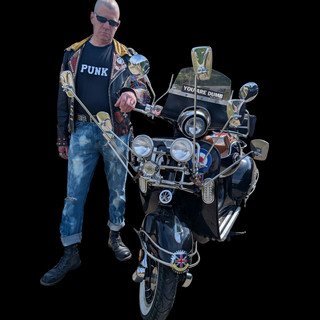
In some ways it made perfect sense. Hardcore was faster, stripped down and less interested in some of the theatrical parts of the earlier punk look. The clothes followed the music. But not everybody went that direction. I didn't. I've always leaned toward the UK punk look. And apparently, more than forty years later, I still haven't gotten it out of my system. I've still got my blue mohawk. Put me in the middle of a hardcore crowd and I'm usually pretty easy to find.
I'm the Sex Pistol in a sea of hardcore kids.
And that's another thing worth remembering about punk clothing back then.
There wasn't just one punk uniform. The look kept changing. Different scenes looked different. Different bands influenced different people. Hardcore kids didn't necessarily look like the punks who came before them, and the next group didn't necessarily look like us. We borrowed things from bands, from other punks, from album covers, from people we saw at shows, and then we made our own versions. That was the fun of it. You didn't need somebody to sell you the look. You figured out what punk looked like on you.
Flash Forward Forty-Something Years
Okay, let's jump ahead more than forty years. Today, if you want punk clothes, you've got options. A lot of options. You can walk into Hot Topic and find band shirts, belts, patches, pants, jackets, accessories, and all kinds of other stuff. Some of it is overpriced shit. Some of it is just shit. But they also run sales and clearance, and if you look around, you can find things pretty cheap.
Then there's Amazon. Go on Amazon and search for "punk clothing." You'll find more stuff than we could have imagined in 1982. Some of it is affordable. Some of it is probably crap. Some of it is affordable because it's crap. But it's there. And before anybody thinks I'm about to go on some old-punk rant about how buying punk clothes makes you a poser, let me get something out of the way: Yeah. I buy stuff from these places too. I'm not going to bullshit you. If I see something I like and the price is right, I might buy it. The point isn't that buying punk clothing is somehow wrong. The point is that today we have choices we simply didn't have back then.
The Internet Changed Everything
Once you get beyond the big retailers, the internet opens up an entire world of punk clothing. There are punk shops all over the place now. Some are expensive. Some aren't. Some sell mass-produced stuff. Others are small independent businesses run by people who actually came out of punk scenes.
Angry, Young and Poor is one example. It was started by punks and has been around for decades. There are plenty of other independent punk shops online too. You can find shirts, boots, jackets, patches, studs, belts, pants, records, pretty much anything you want if you're willing to spend enough time searching for it.
That's a massive difference from when we were kids. Back then, if you lived somewhere without a punk shop, you couldn't just pull a phone out of your pocket and have punk clothes delivered to your house. We didn't have that option. You do. And there's nothing wrong with using it.
You Can Even Make One-Off Stuff Now
Technology has also given us some incredible DIY tools. You can design something on a computer and have it printed onto a shirt. You can make patches. You can have stickers printed cheaply. You can use transfer paper, cutting machines, screen-printing kits, fabric printers, local print shops, and all kinds of tools that either didn't exist or weren't realistically available to a bunch of broke kids in the early '80s.
Print-on-demand has made it possible to create a single shirt without buying screens, ink, equipment, or fifty blank shirts. For your own original artwork, your own band, your own zine, or something you've got permission to reproduce, that's a fantastic tool.
Want one MAPA shirt? I can design one and have one made. Want twenty? I can do that too. No boxes of unsold shirts sitting around for the next ten years. We would have killed for some of these tools in 1982. but here's the funny thing.
I'd Still Tell You to Make It Yourself
With all those choices available, I still think there's something cooler about walking into a thrift store, finding something nobody else wants, taking it home, and fucking with it. Get a jacket for ten bucks. Paint it. Draw on it. Sew something onto it. Put studs in it. Move a zipper somewhere it has absolutely no business being. Cut the sleeves off. Screw it up. Fix it. Screw it up again. Keep going until it's yours.
Grab an old T-shirt and some fabric paint and make a shirt. Make your own patch. Paint the back of your jacket. Take two pieces of clothing and turn them into one. You don't need to make everything you wear. I don't. Buy the boots. Buy the belt. buy a shirt from a band at their show, and if you can, that's one of the best places to spend your money because you're supporting the band directly. Order something online because you think it's cool. Who cares? But make something too. Because there's a difference between finding something that fits your style and creating something that couldn't have existed until you made it. That's the part of punk clothing I don't want us to lose.
The Tools Changed. DIY Didn't.
In 1982, we made punk clothes partly because we didn't have much choice. We didn't have the stores. We didn't have the internet. We didn't have much money. So, we took whatever we could find and figured something out. In 2026, you don't have to do that. And maybe that's exactly why you should try it. Not because homemade clothes make you more punk than somebody else. Not because buying something from Hot Topic automatically makes somebody a poser. And definitely not because everybody needs to dress like it's 1982 again.
Make something because nobody else will have exactly what you made. It might look great. It might look like shit. It might start out looking like shit and become your favorite jacket. That's DIY. The technology is different. The stores are different. The prices are definitely different. But an old jacket, a couple of Sharpies, some paint, a needle and thread, and a bad idea can still go a long way.
You can buy punk clothing. But making your own is still cooler.


Comments